EN
OnEfficiency.StopStart

Engine off - efficiency on

OnEfficiency.StopStart

Stop-start system for locomotives

Making freight transport by rail more efficient – that is our goal. The question of how we achieve this together with you is what moves us.

The locomotive's traction diesel engine is a crucial starting point. Loading and unloading as well as line bottlenecks result in long waiting times every day in rail freight transport. As a consequence, shunting locomotives are operated at idle for up to 70% of their service life. This is where the automatic stop-start system OnEfficiency.StopStart comes in. By switching off the engine during waiting times, high operational savings are possible. Thanks to simultaneous monitoring of the auxiliary operations by our system, nothing stands in the way of continuing the journey. Together with us, take the decisive step towards efficient rail freight transport. Our experts can handle the full support on your behalf – from design to certification.

Portrait picture of Sebastian Piffka
Our G1206 shunting locomotives have a high idle share that cannot be further reduced operationally. For both economic and ecological reasons, we have therefore decided to equip our fleet with OnEfficiency.StopStart.
Sebastian Piffka, Head of technology division, RTB CARGO GmbH
Red signal light indicates that the block section ahead is occupied and the train must stop.
720.000
720.000
The stop-start technology reduces the idle time of the engine by 720 hours per year on average.
30000
30000
On average, 30,000 kg of CO2 can be saved per locomotive in one year.
20000
20000
An average of 20,000 € can be saved per locomotive each year thanks to reduced fuel and maintenance costs.
11000
11000
An average of up to 11,000 liters of fuel saved per engine every year results in lower fuel costs and fewer refueling stops.

Additional functions

With OnEfficiency.StopStart, we support you in achieving your maintenance goals: The highest possible availability with the lowest possible maintenance effort. You can also benefit from additional functions with the technology behind the automatic stop-start.

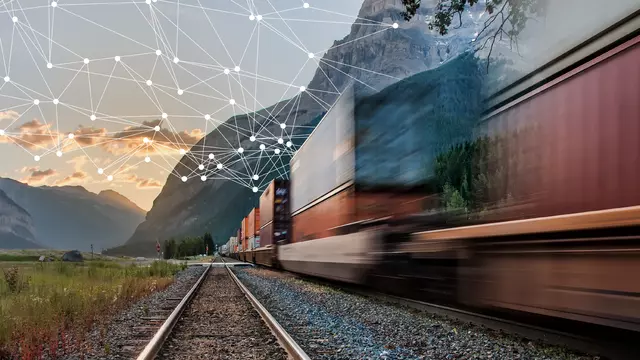
Freight train travels towards sunrise through a mountainous landscape while a digital data network is spreading out from the vehicle.

Fleet management systems provide you with the information you need to continuously optimize your vehicles and maintenance processes. Therefore, we enable you to integrate such systems as OnCare.Asset Rail with the technology behind the stop-start system.

CONTACT OUR EXPERTS

FAQ

With which locomotives and vehicles is OnEfficiency.StopStart compatible?

In principle, OnEfficiency.StopStart is compatible with all diesel locomotives that are already equipped with an electronic control system (e.g. KM-Direkt). Diesel-electric locomotives can also be equipped with the system.

Does OnEfficiency.StopStart lead to higher wear on the starter, engine or other components?

No increased wear was observed either in the Voith test locomotive—which has been equipped with the stop-start system for over 10 years (standard starter, 1,000 kW motor power, 10BB locomotive)—or in any of our other projects with our customers.

Is stop-start operation a safe option for diesel engines?

Voith has been working closely with engine manufacturers on this question since the development phase of OnEfficiency.StopStart. We considered expert advice from Caterpillar/Zeppelin and MTU in the design and parameterization of the stop-start function. The result is a system that respects all the essential conditions specified by the manufacturers for the stop-start operation of modern diesel engines and prioritizes their protection:

  • The engine is started and stopped only in the operating conditions approved by the engine manufacturer
  • Engine-internal protective functions are not bypassed
  • The load on the engine is kept low by only shutting it down after a long shutdown time is detected with the associated low starting frequency

If you would like individual clarification with your motor manufacturer, we will be happy to assist you.

Is OnEfficiency.StopStart a standard solution?

Yes. We offer a standardized solution for G1000, G1206 and BR203.1 locomotives that can be implemented quickly and easily.

How long does it take to install OnEfficiency.StopStart?

Installation of the standardized solutions for the G1000 and G1206 typically takes 2–3 days in the workshop. For the BR203.1, it takes approximately 4 days.
For other locomotive types, the time required must be estimated on a case-by-case basis.

Does OnEfficiency.StopStart lead to higher wear on the starter, engine or other components?

No increased wear was found both in Voith’s test locomotive (standard starter, 1,000 kW engine output, 10BB locomotive), which has been equipped with the Stop-Start system for seven years, nor in the joint pilot projects with our customers.

Are there any references?

OnEfficiency.StopStart is in use by many customers. For example, the system is successfully in use on locomotives operated by Rurtalbahn (G1206), ETF (G1206), Northrail (G1206), Rotterdam Rail Feeding (BR203.1), CFL Cargo (G1000), Alpha Trains (G1206), and many other customers.

Does OnEfficiency.StopStart place a greater load on the battery system?

In theory, a greater load on the battery system is possible; however, no such wear and tear has been observed in previous projects.
In addition, we offer a retrofit with UltraCaps, which enables the starting process to be powered entirely by capacitors and provides optimal protection for the vehicle’s electrical system against potential wear and tear.

Do I need a further certification when equipping a locomotive with the stop-start system?

The system is delivered with an expert opinion and is subject to notification. However, due to the special system architecture, there is no need for further certification.

Does OnEfficiency.StopStart also work in radio remote control mode?

Yes, OnEfficiency.StopStart also functions without restriction in radio remote control mode.

What is the lifetime of OnEfficiency.StopStart?

The components of the system are maintenance-free and durable. The exact service life depends on various environmental factors, but is at least 16 years.

Does OnEfficiency.StopStart meet all standards?

During the development and design of the stop-start system, all relevant railway standards such as EN45545-2, EN50155 and EN50567 were taken into account.

Does OnEfficiency.StopStart have an influence on the safety deadman circuit?

No, OnEfficency.StopStart does not influence the safety deadman circuit.

When using OnEfficiency.StopStart does the software of the vehicle control system have to be adapted?

No, this is not necessary. OnEfficiency.StopStart is designed in such a way that there is no need to interfere with the existing software architecture.

Can OnEfficiency.StopStart be switched on and off manually?

Yes, it is possible to manually enable or disable the runtime control system at the control panel. It can also be permanently disabled using the included counter-plug.

When does OnEfficiency.StopStart become active?

After checking various conditions, the OESS system is automatically activated and the system switches the locomotive’s diesel engine off and on again automatically.

Activation sequence of OnEfficiency.StopStart

Can the parameterization of the stop-start system be adjusted after commissioning?

We transfer the software for parameterization after commissioning, so that parameter adjustments by the vehicle keeper are possible at any time.

In which countries can OnEfficiency.StopStart be used?

The system can be approved and displayed in all countries. Currently, OnEfficiency.StopStart is installed for customers in Germany, France, Netherlands and Luxembourg.

At what stop-time is the use of the automatic stop-start function appropriated?

Since the stop-start system does not shut off the engine until after a waiting period of approximately 3 minutes, we recommend using it when the vehicle is expected to be stationary for at least 5–10 minutes. We have found that the times mentioned above yield the best results in terms of energy efficiency.

How long does it take for all systems to be up and running again?

Continuous monitoring of all relevant systems ensures that they remain operational even while the engine is stopped. The locomotive can therefore be put back into service immediately after the engine is started (approx. 3–5 seconds).

What changes are caused by the installation of OnEfficiency.StopStart on the vehicle?

An additional control cabinet, compressed air sensors, and illuminated pushbuttons are installed in the vehicle. However, no changes are made to the existing vehicle control system, and OnEfficiency.StopStart has no adverse effects on the existing vehicle system. The entire stop-start system can be easily reverted at any time. Optionally, the original configuration of the vehicle’s electrical system can be restored using a counter plug. The OnEfficiency.StopStart control cabinet is completely decoupled from the vehicle using the supplied counter plug, which may be necessary, for example, prior to approval of the modification notice.

At what intervals must the stop-start system be serviced?

The complete OnEfficiency.StopStart system does not require preventive maintenance. However, a daily visual inspection is recommended.

RIGHT OFFCANVAS AREA