
Today’s challenge:
Ensuring grid stability
Grid stability is a must, not an option.
Electrical energy is essential to modern life because it powers the technologies and systems that drive prosperity, enable social progress, and strengthen the wealth and well-being of communities, making the stability of the power grid a critical foundation for sustaining these benefits.
The increased participation of non-dispatchable sources, such as wind and solar, in the energy system, along with the construction of long transmission lines with High Voltage Direct Current (HVDC) technology, has created additional needs for reactive power, inertia, and short-circuit capacity to stabilize the grid.
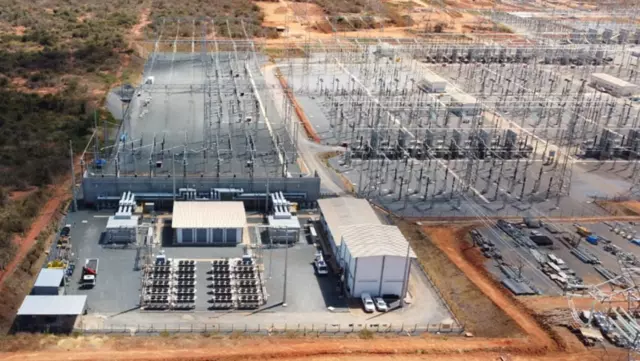
Synchronous condensers stand out for their reliability, proven performance, and attractive cost-benefit. Unlike static solutions, they are rotating machinery, which enables them to deliver much more than just reactive power.They play a key role for grid stability in case of large disturbances, helping to avoid blackouts or brownouts.
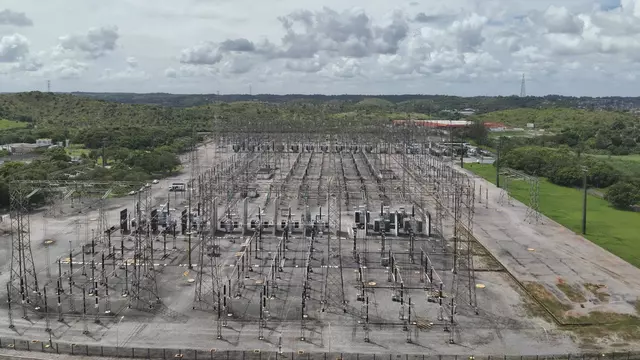
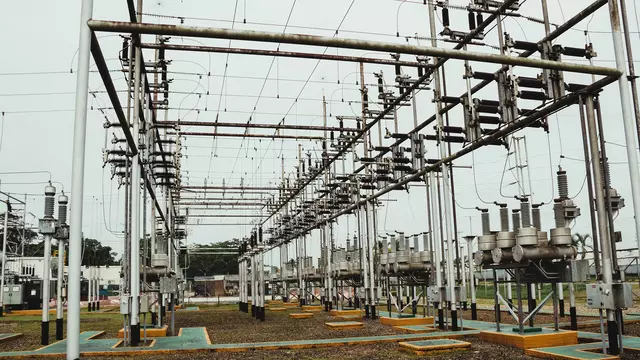
Typically installed at substations at the end of large transmission lines or at critical connection nodes, AC/DC converter stations, or at large electro-intensive consumers, synchronous condensers add physical inertia, stabilizing the grid against frequency fluctuations and keeping the Rate of Change of Frequency (RoCoF) low, even in case of sudden shifts in power generation or consumption. If required, the inertia can be further expanded by integrating external flywheel systems.
They also provide high short-circuit power to trigger protective breakers, which static systems cannot deliver. Synchronous condensers can deliver fault current levels as high as five times their nominal rating.
Their reactive power output increases when voltage decreases, making them superior to static devices for voltage regulation during faults. Unlike static capacitor banks, which only supply reactive power and cannot absorb it, a synchronous condenser can seamlessly transition between supplying reactive power (acting as a capacitor) and absorbing reactive power (acting as an inductor) by adjusting its field excitation. Synchronous condensers are specially designed to provide an extended, time-limited overload capability, sustaining an additional 50% output or more for up to 30 seconds or even longer.
Voith synchronous condensers
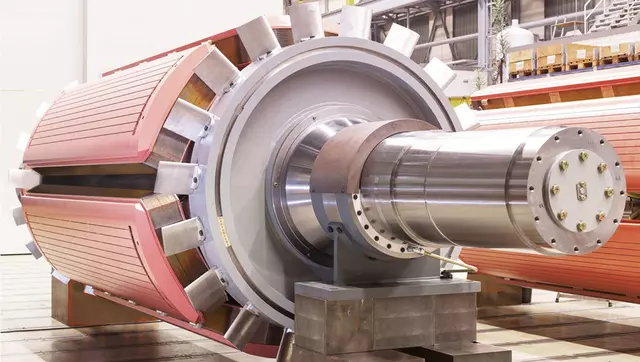
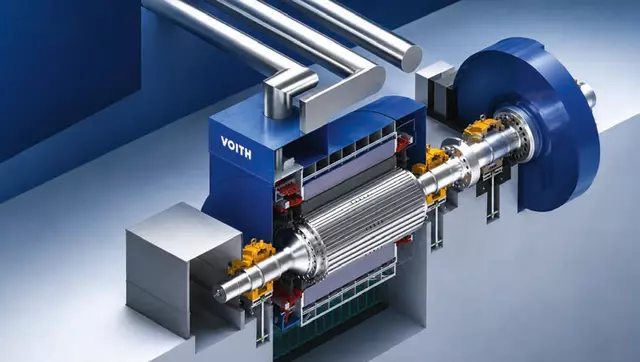
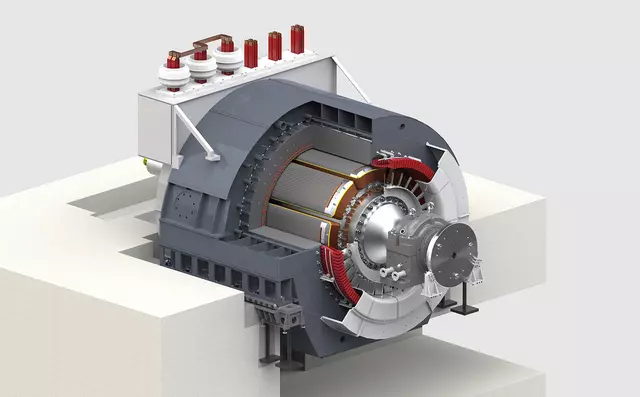
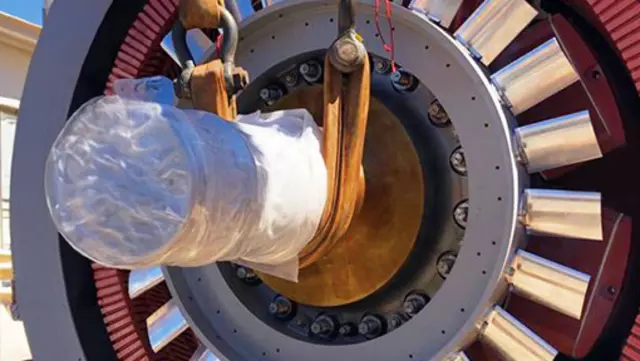
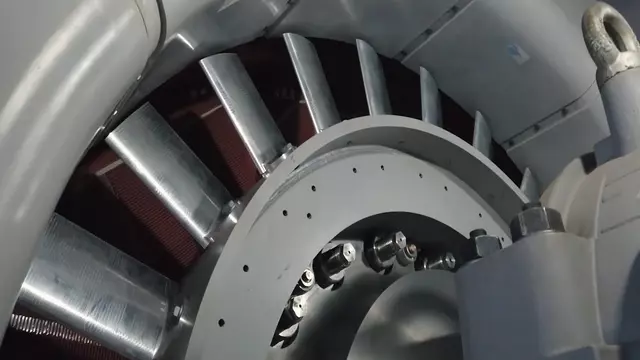
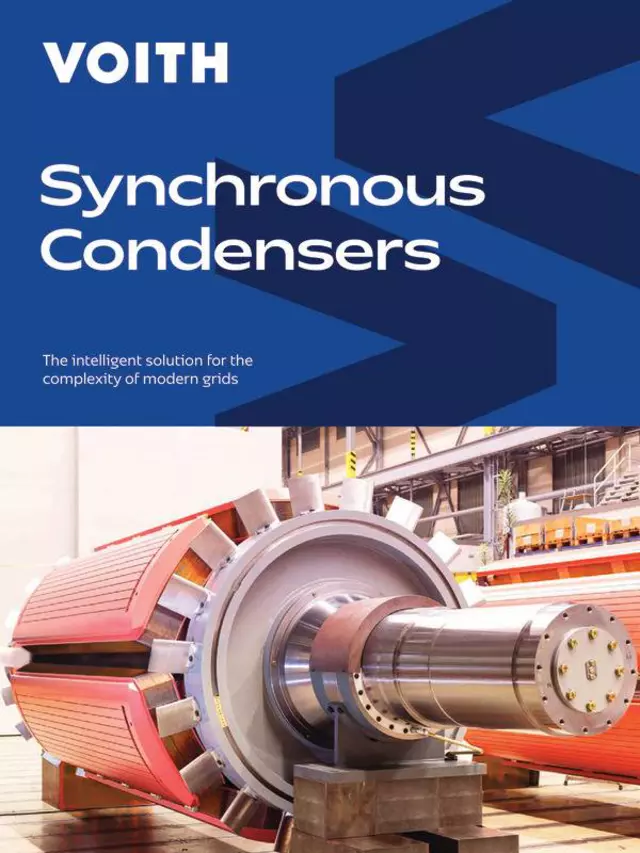
The Voith salient pole machine design offers major advantages compared to other concepts based on cylindrical rotors. The larger inertia provides high grid stability, requires less maintenance, and is easier to service. They have an outstanding smooth operation with very low vibrations in the shaft line system.
Salient pole machines have lower losses and provide a wider under-excited (leading operation) capability. They also offer improved voltage support during the most severe faults (such as 3-phase or 2-phase short circuits). Since they do not require a hydrogen environment for operation, they are inherently safer and much easier to maintain.
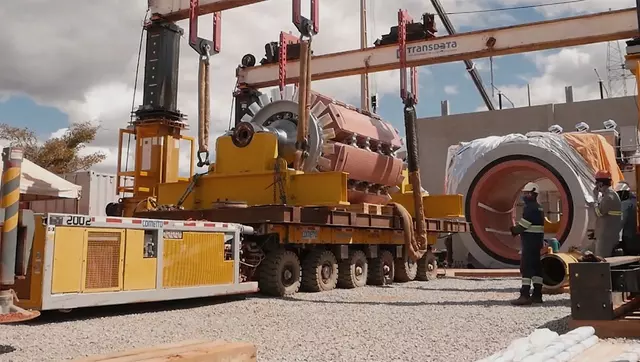
The Voith solution offers concrete benefits to its customers:
- Standardized equipment and systems
- Wide application range (more than 300 Mvar)
- Projects designed with high reliability factors
- Engineering and R&D expertise.
- All parts are modeled in accordance with BIM standards.
- On demand, a dedicated current injection method ensures suitable loads on the brushes regardless of the machine’s output, reducing brush wear and carbon dust.
Selecting a Voith synchronous condenser
All Voith standard synchronous condensers share the following characteristics:
- The active parts have the same dimensions and masses, the same number of slots, bars, poles, for both applications at 50 or 60 Hz.
- Machines are horizontal, three-phase, AC-type, air-cooled, and designed with either an open-circuit or closed-circuit cooling system and static excitation. The starting method is via an SFC. One SFC can start several machines in sequence avoiding the need of one pony-motor for every machine, thus reducing losses and maintenance efforts.
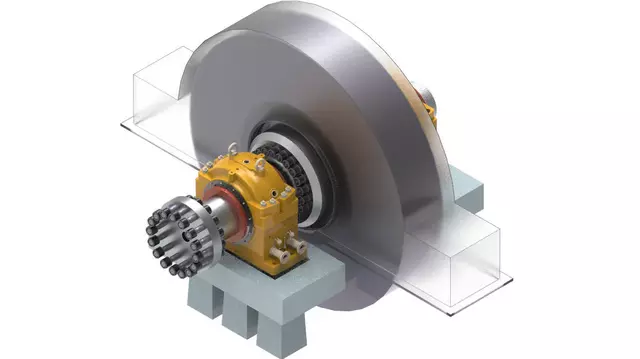
If the inertia provided by the rotor of the machine is not sufficient to cope with the grid needs, a flywheel of adequate size can be supplied. It is mounted on its own shaft and supported by two additional bearings. Inertia constant H up to 10 s or more are doable. In the standard execution the flywheel spins in atmospheric pressure air avoiding vacuum chamber, sealing system and pumps, thus reducing maintenance efforts.
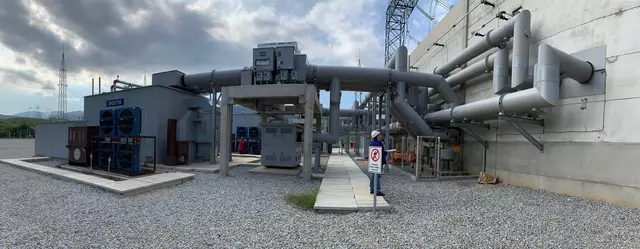
Voith synchronous condensers are designed for both indoor and outdoor installation. For outdoor installations, the machine must always be completely enclosed (TEWAC: Totally Enclosed Water-to-Air-Coolers), with water-to-air coolers installed in the machine and external coolers to cool down the water used for the cooling of the internal air in the machine.
In the TEWAC design, the cooling system is a closed-loop type, i.e., cooling air circulates in a closed circuit inside the machine. Cold air from the water-to-air coolers enters axially on both sides, due to the negative pressure created by axial fans. After thermal exchange, the hot air returns to the water-to-air coolers, and the cycle continues. The cooling water also circulates in a closed circuit, either to a dry-cooler system — where radiators with electric fans blow ambient air to cool the water to the designed temperature — or to a wet cooling tower. The dry-cooler system or wet cooling tower is always installed outside, even for indoor installations.
For indoor installation, the machine is installed inside a shed, and either an open or closed cooling system can be used.
In the open-loop cooling system, no water-to-air coolers or external coolers are necessary. Cold air is drawn from outside the shed by the negative pressure created by axial fans. At the entrance to the shed, the air passes through shutters and filters installed on the wall. After thermal exchange, the hot air is expelled on the opposite side through a duct. Noise dampers are installed at the end of this duct.
In open-loop cooling systems, the cold air temperature is always equal to the ambient temperature. For example, if the ambient temperature is 40°C, the cold air inside the machine will also be at 40°C.
In closed-loop systems, if the ambient temperature is 40°C, this will be the cooling air temperature at the dry-cooler system. Consequently, the water temperature in the water-to-air-coolers will be higher than 40°C, and the cooling air inside the synchronous condenser can be up to 15°C higher than the ambient temperature — i.e. up to 55°C. In locations where the ambient temperature is always low, and it is possible to maintain the water temperature at or below 30°C, the synchronous condenser overexcited outputs (Mvar) can match those of the open-loop cooling system, as shown in the table.
Product portfolio
VHSC 150
| Inner coolant | Air | Air | Air | Air |
|
Max. ambient temperature |
40 °C | 40 °C | 40 °C | 40 °C |
| Temperatures | Class 130 | Class 130 | Class 130 | Class 130 |
| Overload capacity | 1.5 x rated current for 30 s | 1.5 x rated current for 30 s | 1.5 x rated current for 30 s | 1.5 x rated current for 30 s |
| Frequency | 50 Hz | 50 Hz | 60 Hz | 60 Hz |
| Rated speed | 750 rpm | 750 rpm | 900 rpm | 900 rpm |
| Rated voltage | 11.5 kV | 11.5 kV | 13.8 kV | 13.8 kV |
| Cooling type | Open loop or TEWAC (water ≤ 30 °C) | TEWAC with dry coolers | Open loop or TEWAC (water ≤ 30 °C) | TEWAC with dry coolers |
| Overexcited output at rated voltage (at step-up transformer leads) | 135 Mvar | 125 Mvar | 165 Mvar | 150 Mvar |
|
Underexcited output at SC rated voltage at GSUT HV leads and Ifmin ~ 0.1 If0 |
100 | 100 | 120 | 120 |
| Short-circuit power at GSUT HV leads | 525 MVA | 525 MVA | 625 MVA | 625 MVA |
| Inertia constant H at max. overexcited output (at SC leads) without flywheel | 1.9 s | 2.1 s | 2.3 s | 2.5 s |
|
Inertia constant H at max. overexcited output (at SC leads) with flywheel |
Up to 10 s | Up to 10 s | Up to 10 s | Up to 10 s |
| Excitation type | Thyricon 500 | Thyricon 500 | Thyricon 500 | Thyricon 500 |
| Noise level (ISO 3746) | 85 dBA at 5 m from shed | 85 dBA at 1 m | 85 dBA at 5 m from shed | 85 dBA at 1 m |
VHSC 300
| Inner coolant | Air | Air | Air | Air |
|
Max. ambient temperature |
40 °C | 40 °C | 40 °C | 40 °C |
| Temperatures | Class 130 | Class 130 | Class 130 | Class 130 |
| Overload capacity | 1.5 x rated current for 30 s | 1.5 x rated current for 30 s | 1.5 x rated current for 30 s | 1.5 x rated current for 30 s |
| Frequency | 50 Hz | 50 Hz | 60 Hz | 60 Hz |
| Rated speed | 750 rpm | 750 rpm | 900 rpm | 900 rpm |
| Rated voltage | 12.5 kV | 12.5 kV | 15.0 kV | 15.0 kV |
| Cooling type | Open loop or TEWAC (water ≤ 30 °C) | TEWAC with dry coolers | Open loop or TEWAC (water ≤ 30 °C) | TEWAC with dry coolers |
| Overexcited output at rated voltage (at step-up transformer leads) | 250 Mvar | 225 Mvar | 300 Mvar | 270 Mvar |
|
Underexcited output at SC rated voltage at GSUT HV leads and Ifmin ~ 0.1 If0 |
190 | 190 | 240 | 240 |
| Short-circuit power at GSUT HV leads | 1050 MVA | 1050 MVA | 1250 MVA | 1250 MVA |
| Inertia constant H at max. overexcited output (at SC leads) without flywheel | 2.6 s | 2.9 s | 3.2 s | 3.5 s |
|
Inertia constant H at max. overexcited output (at SC leads) with flywheel |
Up to 10 s | Up to 10 s | Up to 10 s | Up to 10 s |
| Excitation type | Thyricon 500 | Thyricon 500 | Thyricon 500 | Thyricon 500 |
| Noise level (ISO 3746) | 85 dBA at 5 m from shed | 85 dBA at 1 m | 85 dBA at 5 m from shed | 85 dBA at 1 m |
Design and tolerances according to IEC 60034-1 / IEC 60034-3 / IEC 60034-33.
GSUT (Generator Set-Up Transformer) taps with OLTC (On-Load Tap Changer) at the High-Voltage side with tap range sufficient to keep the voltage in the rage of +/-5 % of the rated value.





References in recent years
| 1974 | Dutra I/II, Brazil 100 MVAr, 02 Units |
|
1978 |
Recife II, Brazil 150 MVAr, 01 Unit |
| 1982 | Teresina II, Brazil 150 MVAr, 01 Unit |
| 2015 | Riel, Canada -125/ +250 MVAr, 04 Units |
| 2016 | Janaúba, Brazil -90/ +150 MVAr, 02 Units |
| 2017 | Terminal Rio, Brazil -75/ +150 MVAr, 02 Units |
| 2017 | Rurópolis, Brazil -55/ +110 MVAr, 01 Unit |
|
2017 |
Tapajós, Brazil -75/ +150 MVAr, 01 Unit |
| 2017 | Ariquemes, Brazil -90/ +150 MVAr, 01 Unit |
| 2017 | Ji-Paraná, Brazil -90/ +150 MVAr, 01 Unit |
| 2020 | Janaúba, Brazil -90/ +150 MVAr, 01 Unit |
How can we help you?
Get in contact with us
Voith Hydro Holding GmbH & Co. KG
Alexanderstraße 11 89522 Heidenheim, Germany